Circular Economy and Waste Management towards Sustainable Development Editorial
Article Sidebar
Main Article Content
Abstract
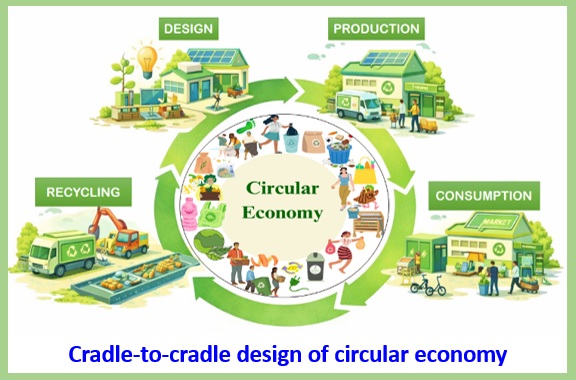
The vital principles of the circular economy are the utilization of waste as a valuable resource to create a value-added product, known as the "cradle-to-cradle" design approach (Fig. 1). The key approaches of circular economy apply lifecycle thinking, inspire the design of products, materials, and systems that minimize waste production, encompass product durability, and exploit resource efficiency in every stage of the value chain. Unlike conventional linear “cradle -to-grave” model, a circular economy prioritizes closed-loop systems in which materials are incessantly recuperated, recycled, and renewed. In this respect, special consideration is required to innovate in sustainable manufacturing, eco-design, remanufacturing, and resource recovery processes lowering the reliance on virgin raw materials and decreasing environmental impacts. The successful implementation of the circular economy needs progressive policy frameworks, effective legislation, economic incentives, new business models, investor collaboration, and community-driven creativity to inspire sustainable deployment and conscientious waste utilization practices that leads significant environmental, economic, and social benefits. Environmentally, the goals of circular economy are to minimize greenhouse gas emissions, protection of natural resources, and reduced landfill dependence. The role of government agencies, industrial houses, and local policy makers is crucial in making rewarding institutional and social conditions that are obligatory for long-term circularity.
Article Details

This work is licensed under a Creative Commons Attribution 4.0 International License.
How to Cite




References
M. Ram, E. Bracci. Waste Management, Waste Indicators and the Relationship with Sustainable Development Goals (SDGs): A Systematic Literature Review. Sustainability 2024, 16, 8486. https://doi.org/10.3390/su16198486. DOI: https://doi.org/10.3390/su16198486
M. Monfared, F. Marandi, P. C. Sauer. Achieving sustainable development by integrating circular economy principles into solid waste management: A systematic literature review and research agenda. Int. J. Production Economics, 2025, 290, 109787. https://doi.org/10.1016/j.ijpe.2025.109787. DOI: https://doi.org/10.1016/j.ijpe.2025.109787
D. Zhao, Y. Chen, H. Yuan, D. Chen. Life cycle optimization oriented to sustainable waste management and circular economy: A review. Waste Manag., 2025, 191, 89. https://doi.org/10.1016/j.wasman.2024.11.001. DOI: https://doi.org/10.1016/j.wasman.2024.11.001
S. Zavos, T. Lehtokunnas, O. Pyyhtinen. The (missing) social aspect of the circular economy: a review of social scientific articles. Sustain Earth Reviews, 2024, 7, 11. https://doi.org/10.1186/s42055-024-00083-w. DOI: https://doi.org/10.1186/s42055-024-00083-w
I. D'Adamo, C. Daraio, S. Di Leo, M. Gastaldi, E. N. Rossi. Driving EU sustainability: Promoting the circular economy through municipal waste efficiency. Sustain. Prod. Consum., 2024, 50, 462. https://doi.org/10.1016/j.spc.2024.08.022. DOI: https://doi.org/10.1016/j.spc.2024.08.022
M. Geissdoerfer, P. Savaget, N. M. Bocken, E. J. Hultink. The Circular Economy – A new sustainability paradigm? J. Clean. Prod., 2017, 143, 757. https://doi.org/10.1016/j.jclepro.2016.12.048. DOI: https://doi.org/10.1016/j.jclepro.2016.12.048
S. Kaza, L. Yao, P. Bhada-Tata, F. Van Woerden. What a Waste 2.0: A Global Snapshot of Solid Waste Management to 2050. World Bank. 2018. https://doi.org/10.1596/978-1-4648-1329-0. DOI: https://doi.org/10.1596/978-1-4648-1329-0
J. Kirchherr, D. Reike, M. Hekkert. Conceptualizing the circular economy: An analysis of 114 definitions. Resour. Conserv. Recycl., 2017, 127, 221. https://doi.org/10.1016/j.resconrec.2017.09.005. DOI: https://doi.org/10.1016/j.resconrec.2017.09.005
UNEP. Global Waste Management Outlook 2024. United Nations Environment Programme (2024).