
In Silico Evaluation of Microplastics Interactions for Storage of a Multi-Epitope Vaccine Candidate Computational Chemistry
Article Sidebar
Main Article Content
Abstract
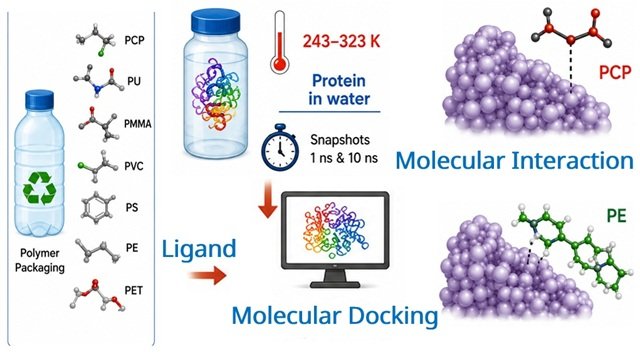
The increasing prevalence of multidrug-resistant disease has addressed an urgent requirement for early prophylactic therapies like a vaccine. Their therapeutic efficacy entirely depends on the supply chain & storage parameters. Conventional vaccine formulations have mainly used glass vials, while polymer-based packaging offers reduced package volume, weight and price per dose. But the emergence of microplastics (1-10 μm) as leachable from those polymeric containers may destabilize the vaccine product and toxify the human CYP1A1 protein. Leaching may also occur under different storage temperature conditions. For this, all-atom molecular dynamics simulation on the multi-epitope vaccine was conducted under the OPLS-AA force field, NaCl-neutralized SPC water model, 1atm pressure, and varying storage temperatures. These systems were energy-minimized and equilibrated under constant NVT and NPT conditions for 100 ps, followed by a 10 ns production simulation. Blind & flexible docking of the simulated vaccine snapshots with monomeric polymer structures (i.e., PET, PU, PMMA, PVC, PS, PE, PCP) yielded insights into polymer-vaccine interactions. Initially, both docking methods yielded PCP, a non-biodegradable polymer as weakest binder. Thus, the current investigation may serve as a basis for further studies to validate the suitability of PCP derived vials for vaccine storage.
Article Details

This work is licensed under a Creative Commons Attribution 4.0 International License.
How to Cite




Funding data
References
P. Sadhukhan, A. Mallick, B. Pal, N. Mahata. Eco-friendly sustainable vaccine designing technology aiding personalised immunotherapy: medicinal chemistry. Innov. Chem. Mater. Sustain., 2025, 2, 93. https://doi.org/10.63654/icms.2025.02093 DOI: https://doi.org/10.63654/icms.2025.02093
P. Sadhukhan, N. Mahata. Immunoinformatics-guided design and molecular evaluation of a TLR4-adjuvanted multiepitope vaccine against multidrug-resistant Enteroinvasive Escherichia coli and Shigella spp. In Silico Pharmacol., 2026, 14, 130. https://doi.org/10.1007/s40203-026-00618-3 DOI: https://doi.org/10.1007/s40203-026-00618-3
S. Pagliusi, S. W. Jarrett, R. Park, Y. Bramanti, R. Menon, C. Jarrahian, C. Frivold, L. Yang. Innovative vaccine packaging technologies: perspectives on benefits and challenges of compact prefilled auto-disable devices and polymer containers. J. Adv. Manuf. Process 2023, 5, e10152. https://doi.org/10.1002/amp2.10152 DOI: https://doi.org/10.1002/amp2.10152
D. Ramakanth, S. Singh, P. K. Maji, Y. S. Lee, K. K. Gaikwad. Advanced packaging for distribution and storage of COVID-19 vaccines: a review. Environ. Chem. Lett., 2021, 19, 3597. https://doi.org/10.1007/s10311-021-01256-1 DOI: https://doi.org/10.1007/s10311-021-01256-1
N. Hirt, M. Body-Malapel. Immunotoxicity and intestinal effects of nano- and microplastics: a review of the literature. Part. Fibre Toxicol., 2020, 17, 57. https://doi.org/10.1186/s12989-020-00387-7 DOI: https://doi.org/10.1186/s12989-020-00387-7
S. O. Elshafei, N. A. Mahmoud, Y. A. Almofti. Immunoinformatics, molecular docking and dynamics simulation approaches unveil a multi epitope-based potent peptide vaccine candidate against avian leukosis virus. Sci. Rep., 2024, 14, 2870. https://doi.org/10.1038/s41598-024-53048-6 DOI: https://doi.org/10.1038/s41598-024-53048-6
S. Chowdhury, P. Sadhukhan, N. Mahata. Immunoinformatics investigation on pathogenic Escherichia coli proteome to develop an epitope-based peptide vaccine candidate. Mol Divers., 2025, 29, 4293. https://doi.org/10.1007/s11030-024-11034-0 DOI: https://doi.org/10.1007/s11030-024-11034-0
A. K. Keshri, R. Kaur, S. S. Rawat, N. Arora, R. K. Pandey, B. V. Kumbhar, A. Mishra, S. Tripathi, A. Prasad. Designing and development of multi-epitope chimeric vaccine against Helicobacter pylori by exploring its entire immunogenic epitopes: an immunoinformatic approach. BMC Bioinform., 2023, 24, 358. https://doi.org/10.1186/s12859-023-05454-2 DOI: https://doi.org/10.1186/s12859-023-05454-2
R. Thakur, V. Joshi, G. C. Sahoo, R. R. Tiwari, S. Rana. In silico analysis of novel triacontafluoropentadec-1-ene as a sustainable replacement for dodecane in fisheries microplastics: molecular docking, dynamics simulation and pharmacophore studies of acetylcholinesterase activity. Comput. Biol. Chem., 2025, 115, 108358. https://doi.org/10.1016/j.compbiolchem.2025.108358 DOI: https://doi.org/10.1016/j.compbiolchem.2025.108358
G. S. PM, N. Abbas, P. S. Dhiwar, E. Singh, A. Ghara, A. Das. Discovery of potential Aurora-A kinase inhibitors by 3D QSAR pharmacophore modeling, virtual screening, docking, and MD simulation studies. J. Biomol. Struct. Dyn., 2023, 41, 125. https://doi.org/10.1080/07391102.2021.2004236 DOI: https://doi.org/10.1080/07391102.2021.2004236
C. E. Enyoh, Q. Wang, P. E. Ovuoraye, T. O. Maduka. Toxicity evaluation of microplastics to aquatic organisms through molecular simulations and fractional factorial designs. Chemosphere 2022, 308, 136342. https://doi.org/10.1016/j.chemosphere.2022.136342 DOI: https://doi.org/10.1016/j.chemosphere.2022.136342
S. Dallakyan, A. J. Olson. Small-molecule library screening by docking with PyRx. In J. Hempel, C. Williams, C. Hong (eds.) Humana Press, New York, NY, Chemical Biology. Methods in Molecular Biology, 2015, 1263, 243-250. https://doi.org/10.1007/978-1-4939-2269-7_19 DOI: https://doi.org/10.1007/978-1-4939-2269-7_19
O. Trott, A. J. Olson. AutoDock Vina: improving the speed and accuracy of docking with a new scoring function, efficient optimization, and multithreading. J. Comput. Chem., 2010, 31, 455. https://doi.org/101002/jcc.21334 DOI: https://doi.org/10.1002/jcc.21334
J. Wang, N. V. Dokholyan. MedusaDock 2.0: Efficient and Accurate Protein-Ligand Docking with constraints. J. Chem. Inf. Model., 2019, 59, 2509. https://doi.org/10.1021/acs.jcim.8b00905 DOI: https://doi.org/10.1021/acs.jcim.8b00905
R. A. Laskowski, M. B. Swindells. LigPlot+: Multiple Ligand–Protein Interaction Diagrams for Drug Discovery. J. Chem. Inf. Model., 2011, 51, 2778. https://doi.org/10.1021/ci200227u DOI: https://doi.org/10.1021/ci200227u
M. Y. Lobanov, N. S. Bogatyreva, O. V. Galzitskaya. Radius of gyration as an indicator of protein structure compactness. Mol. Biol., 2008, 42, 623. https://doi.org/10.1134/S0026893308040195 DOI: https://doi.org/10.1134/S0026893308040195
L. Ding, R. Mao, S. Ma, X. Guo, L. Zhu. High temperature dependent ageing mechanism of microplastics under different environmental conditions and its effect on the distribution of organic pollutants. Water Res., 2020, 174, 115634. https://doi.org/10.1016/j.watres.2020.115634 DOI: https://doi.org/10.1016/j.watres.2020.115634
S. Ghosal, S. Bag, S. Bhowmik. Insights into the Binding Interactions between Microplastics and Human α-Synuclein Protein by Multispectroscopic Investigations and Amyloidogenic Oligomer Formation. J. Phys. Chem. Lett., 2024, 15, 6560. https://doi.org/10.1021/acs.jpclett.4c00731 DOI: https://doi.org/10.1021/acs.jpclett.4c00731
S. Agarwal. Biodegradable polymers: present opportunities and challenges in providing a microplastic-free environment. Macromol. Chem. Phys., 2020, 221, 2000017. https://doi.org/10.1002/macp.202000017 DOI: https://doi.org/10.1002/macp.202000017
B. J. Lohnes, J. Woller, U. F. Hartwig, N. K. Poddar. Exploring the molecular mechanisms of Nanoplastic interactions with blood proteins by molecular dynamics and docking simulations. J. Mol. Liq., 2026, 446, 129304. https://doi.org/10.1016/j.molliq.2026.129304 DOI: https://doi.org/10.1016/j.molliq.2026.129304
S. Rajpal, A. D. Batista, R. Groß, J. Münch, B. Mizaikoff, P. Mishra. Rational design based on multi-monomer simultaneous docking for epitope imprinting of SARS-CoV-2 spike protein. Sci. Rep., 2024, 14, 23057. https://doi.org/10.1038/s41598-024-73114-3 DOI: https://doi.org/10.1038/s41598-024-73114-3
F. Paul, C. Wehmeyer, E. T. Abualrous, H. Wu, M. D. Crabtree, J. Schöneberg, J. Clarke, C. Freund, T. R. Weikl, F. Noé. Protein-peptide association kinetics beyond the seconds timescale from atomistic simulations. Nat. Commun., 2017, 8, 1095. https://doi.org/10.1038/s41467-017-01163-6 DOI: https://doi.org/10.1038/s41467-017-01163-6