
Euphorbia royleana Boiss: A Systematic Review on Traditional Uses, Phytochemistry, Pharmacological Properties and Toxicological Activities Natural Product Chemistry
Article Sidebar
Main Article Content
Abstract
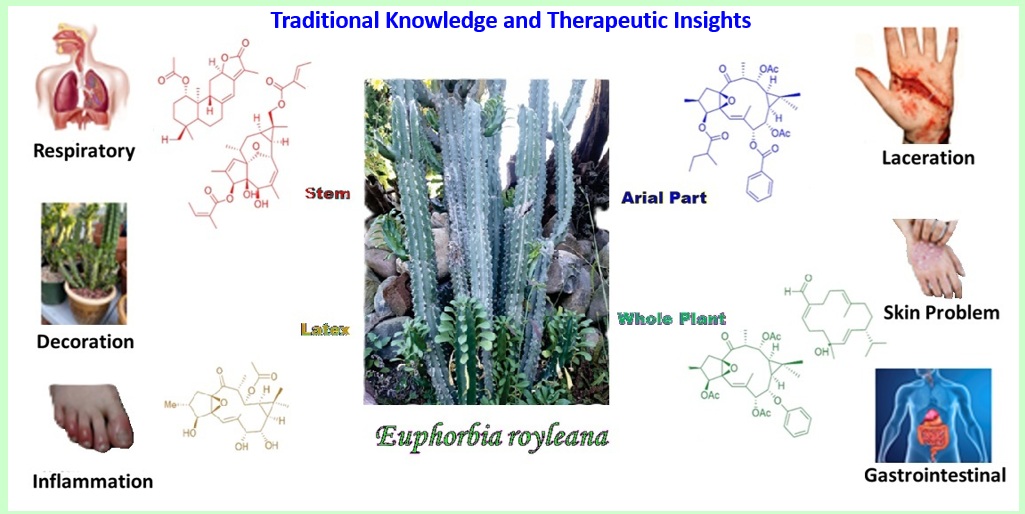
Euphorbia royleana (family: Euphorbiaceae) is a cactus plant bearing milky latex with traditional medicinal uses to treat various diseases and conditions like gastro-intestinal problems, laceration, wounds, earache, skin problems, arthritis etc. This review documents the ethnomedical uses, phytochemistry, pharmacological activities and toxicological studies of E. royleana to identify the remaining gaps and supply a basis for further investigations. The data and information on E. royleana was retrieved using various databases such as PubMed, Springer, Taylor and Francis imprints, ScienceDirect, Google Scholar, ChemSpider, SciFinder, research and review articles from peer-reviewed journals and unpublished data such as PhD thesis, in addition to ethnobotanical books, chapters and Wikipedia. Phytochemical investigations have led to the isolated structurally diverse diterpenoids and triterpenoids with reported pharmacological activities as Anti angiogenic, Inhibiting NO production in BV-2 cells, MDR modulator, in-vitro cytotoxicity. E. royleana is a valuable medicinal source and further studies in this topic can validate the traditional and ethnobotanical use of the plant. Furthermore, there are gaps need to filled before therapeutic uses validation because the long-term in vivo toxicity and clinical efficacy of E. royleana formulations have not been thoroughly demonstrated. The present review thus highlights E. royleana as a pharmacologically valuable yet underexplored medicinal plant and it strongly supports for systematic phytochemical, and clinical investigations.
Article Details

This work is licensed under a Creative Commons Attribution 4.0 International License.
How to Cite




References
M. Kargıoglu, S. Cenkci, A. Serteser, N. Evliyaoglu, M. Konuk, M. S. Kök, Y. Bagcı. An ethnobotanical survey of Inner-West Anatolia. Hum. Eco. 2008, 36, 763. https://doi.org/10.1007/s10745-008-9198-x DOI: https://doi.org/10.1007/s10745-008-9198-x
S. Verma, S. P. Singh. Current and future status of herbal medicines. Vete. World. 2008, 1, 347. https://doi.org/10.5455/vetworld.2008.347-350 DOI: https://doi.org/10.5455/vetworld.2008.347-350
C. T. Che, V. George, T. P. Ijinu, P. Pushpangadan, K. Andrae-Marobela. Traditional medicine. In Pharmacognosy. 2017, 15-30. https://doi.org/10.1016/B978-0-12-802104-0.00002-0 DOI: https://doi.org/10.1016/B978-0-12-802104-0.00002-0
A. G. Atanasov, B. Waltenberger, E. M. Pferschy, T. Linder, C. Wawrosch, P. Uhirin, V. Temm, L. Wang, S. Schwaiger, E. H. Heiss, J. M. Rollinger, D. Schuster, J. M. Breuss, V. Bochkoy, M. D. Milhovilovic, B. Kopp, R. Bauer, V. M. Dirsch, H. Stuppner. Discovery and resupply of pharmacologically active plant-derived natural products: A review. Biotechnol. Adv. 2015, 33,1583. https://doi.org/10.1016/j.biotechadv.2015.08.001 DOI: https://doi.org/10.1016/j.biotechadv.2015.08.001
A. L. Harvey, R. Edrada-Ebel, R. J. Quinn. The re-emergence of natural products for drug discovery in the genomics era. Nat. Rev. Drug Discov. 2015, 14,1. https://doi.org/10.1038/nrd4510 DOI: https://doi.org/10.1038/nrd4510
J. T. Mwine, P. V. Damme. Why do Euphorbiaceae tick as medicinal plants? A review of the Euphorbiaceae family and its medicinal features. J. Med. Plants Res., 2011, 5, 652.
D. Kemboi, X. Peter, M. Langat, J. Tembu. A review of the ethnomedicinal uses, biological activities, and triterpenoids of Euphorbia species. Mol., 2020, 25, 1. https://doi.org/10.3390/molecules25174019 DOI: https://doi.org/10.3390/molecules25174019
G. L. Webster. Classification of the Euphorbiaceae. Ann. Missouri Bot. Gard., 1994, 81, 3. https://doi.org/10.2307/2399908 DOI: https://doi.org/10.2307/2399908
I. K. R. Kgosiemang, R. Lefojane, A.M. Adegoke, O. Ogunyemi, S. S. Mashele, M. P. Sekhoacha. Pharmacological significance, medicinal use, and toxicity of extracted and isolated compounds from Euphorbia species found in southern Africa: A review. Plants 2025, 14, 469. https://doi.org/10.3390/plants14030469 DOI: https://doi.org/10.3390/plants14030469
A. Vasas, J. Hohmann. Euphorbia diterpenes: isolation, structure, biological activity, and synthesis (2008-2012). Chem Rev. 2014, 114, 8579. https://doi.org/10.1021/cr400541j DOI: https://doi.org/10.1021/cr400541j
P. Bigoniya, A. C. Rana. A Comprehensive Phyto-pharmacological Review of Euphorbia neriifolia Linn Pharmacogn Rev., 2008, 2, 57. https://www.cabidigitallibrary.org/doi/full/10.5555/20093039499
B. Salehi, M. Iriti, S. Vitalini, H. Antolak, E. Pawlikowska, D. Kregiel, J. Sharifi-Rad, S. I. Oyeleye, A. O. Ademiluyi, K. Czopek, M. Staniak, L. Custodio, E. Coy-Barrera, A. Segura-Carretero, M. D. L. L. Cádiz-Gurrea, R. Capasso, w. C. Cho, A. M. L. Seca. Euphorbia- derived natural products with potential for use in health maintenance. Euphorbia-Derived Natural Products with Potential for Use in Health Maintenance. Biomolecules 2019, 9, 1. https://doi.org/10.3390/biom9080337 DOI: https://doi.org/10.3390/biom9080337
D. S. Seigler. Phytochemistry and Systematics of the Euphorbiaceae. Ann. MissouriBot.Gard.1994, 81, 380. https://doi.org/10.2307/2992104 DOI: https://doi.org/10.2307/2992104
Q. W. Shi, X. H. Su, H. Kiyota. Chemical and Pharmacological Research of the Plants in Genus Euphorbia. Chem. Rev. 2008, 108, 4295. https://doi.org/10.1021/cr078350s DOI: https://doi.org/10.1021/cr078350s
A. O. Pascal, A. E. V. Bertrand, T. Esaie, H. A. M. Sylvie, A. Y. Eloi. A review of the ethnomedical uses, phytochemistry, and pharmacology of the Euphorbia genus. J. Pharm. Innov., 2017, 6,34.
S. Kumar, R. Malhotra, D. Kumar. Euphorbia hirta: Its chemistry, traditional and medicinal uses, and pharmacological activities. Pharmacogn Rev. 2010, 4, 58. https://doi.org/10.4103/0973-7847.65327 DOI: https://doi.org/10.4103/0973-7847.65327
W. F. Zheng, Z. Cui, Q. X. Zhu. Cytotoxicity and antiviral activity of the compounds from Euphorbia kansui. Planta Medica., 1998, 64, 754. https://doi.org/10.1055/s-2006-957574 DOI: https://doi.org/10.1055/s-2006-957574
Q. Zhang, Q. R. Zhou, J. W. Lou, P. D. Chen, W. Yao, W. W. Tao, Y. P. Tang, G. C. Dai, K. Wang, L. Zhang. Chemical Constituents from Euphorbia kansui. Molecules 2017, 22, 2176. https://doi.org/10.3390/molecules22122176 DOI: https://doi.org/10.3390/molecules22122176
C. Burlakoti, R. M. Kunwar. Folk herbal medicines of mahakali watershed area, Nepal. Medicinal plants in Nepal: An anthology of contemporary research, 2008, 187-193.
M. V. N. L. Chaitanya, P. Suresh. The Neglected Anticancer Phytoceutical Treasures from the Nilgiris Biosphere: A Short Review, J. Pharm. Res. Int., 2018, 22, 1. https://doi.org/10.9734/JPRI/2018/40529 DOI: https://doi.org/10.9734/JPRI/2018/40529
S. K. Sood, S. Thakur. Ethnobotany of Rewalsar Himalaya. Ph.D. thesis. 2004.
S. Aditya. A revision of geophytic Euphorbia species from India. Euphorbia world, 2010, 6,18.
M. Sabeen, S. S. Ahmad. Exploring the Folk Medicinal Flora of AbbotabadCity, Pakistan. Ethnobotan. Leafl. 2009, 13, 810.
S. Tiwari, A. V. Singh. Piscicidal and anti-acetylcholinesterase activity of Euphorbia royleana stem bark extracts against freshwater common predatory fish Channa punctatus. Environ. Toxicol. Pharmacol., 2004, 181, 47. https://doi.org/10.1016/j.etap.2004.05.001 DOI: https://doi.org/10.1016/j.etap.2004.05.001
S. Bani, A. Kaul, B. S. Jaggi, K. A. Suri, O. P. Suri, O. P. Sharma. Anti-inflammatory activity of the hydrosoluble fraction of Euphorbia royleana latex. Fitoterapia. 2000, 71, 655. https://doi.org/10.1016/S0367-326X(00)00225-2 DOI: https://doi.org/10.1016/S0367-326X(00)00225-2
P. Kumari, R. Kaundal, R. Kumar, Y. K. Walia, D. Kumar. Metabolome Analysis and Functional Activities of Euphorbia royleana Boiss. Indicating Potential Health Benefits. Chem & Biod., 2026, 23, 03217. https://doi.org/10.1002/cbdv.202503217 DOI: https://doi.org/10.1002/cbdv.202503217
R. Ullah, S. A. Jan, M. N. Khan, M. Nazish, A. Kamal, A. Kaplan, H. M. Yehia, K. M. Alarjani, R. Alkasir, W. Zaman. Euphorbia royleana Boiss derived silver nanoparticles and their applications as a nanotherapeutic agent to control microbial and oxidative stress-originated diseases. Pharmaceuticals 2023, 16, 1413. https://doi.org/10.3390/ph16101413 DOI: https://doi.org/10.3390/ph16101413
S. Bani, S. Kaul, B. Khan, S. F. Ahmad, K. A. Suri, N. K. Satti, M. Amina, G. N. Qazi. Immunosuppressive properties of an ethyl acetate fraction from Euphorbia royleana. J. Ethnopharmacol., 2005, 99,185. https://doi.org/10.1016/j.jep.2004.12.017 DOI: https://doi.org/10.1016/j.jep.2004.12.017
The Plant List. Version 1.1. Published on the Internet; http://www.theplantlist.org/. 2013.
S. Shakera, J. Sanga, X. L. Yana, R. Fana, G. Tanga, Y. Xub, S. Yina. Diterpenoids from Euphorbia royleana reverse P-glycoprotein-mediated multidrug resistance in cancer cells. Phytochemistry 2020, 176, 112395. https://doi.org/10.1016/j.phytochem.2020.112395 DOI: https://doi.org/10.1016/j.phytochem.2020.112395
P. Wang, C. Xie, L. An, X. Yang, Y. Xi, S. Yuan, C. Zhang, M. Tuerhong, D. Jin, D. Lee, J. Zhang, Y. Ohizumi, J. Xu, Y. Guo. Bioactive diterpenoids from the stems of Euphorbia royleana. J. Nat. Prod., 2019, 82, 183. https://doi.org/10.1021/acs.jnatprod.8b00493 DOI: https://doi.org/10.1021/acs.jnatprod.8b00493
M. R. Paudel, B. Paudel, H. D. Bhattarai, R. M. Kunwar, H. A. Jan, M. A. Turi, R. W. Bussmann, N. Y. Paniagua-Zambrana. Euphorbia hirta L., Euphorbia Pilosa L., Euphorbia royleana Boiss. Ethnobot. Himal., 2021, 1-14. https://doi.org/10.1007/978-3-030-45597-2_97-2 DOI: https://doi.org/10.1007/978-3-030-45597-2_97-2
Euphorbia royleana Boissier in A. Candolle, Prodr. 1862, 15, 83.
Z. Wu, P. H. Raven, D. Hong. Flora of China (2011). Beijing/St. Louis. Science Press/Missouri Botanical Garden Press. 289-300.
Euphorbia royleana Boiss., Flora of Pakistan, Tropicos. org. 2011. https://legacy.tropicos.org/Project/Pakistan
N. A. Harriman. Flora of Pakistan. Economic Botany. 2004, 58, 742. https://doi.org/10.1663/0013-0001(2004)058[0742:BREDFA]2.0.CO;2 DOI: https://doi.org/10.1663/0013-0001(2004)058[0742:BREDFA]2.0.CO;2
C. Y. Wu, P. H. Raven, D. Y. Hong (eds.) Flora of China (2003). Science Press & Missouri Botanical Garden Press, Beijing & St. Louis.
X. G. Lai, Y. B. Yang, X. L. Shan. The investigation of euphorbiaceous medicinal plants in southern china. Economic Botany 2004, 58, S307. https://doi.org/10.1663/0013-0001(2004)58[S307:TIOEMP]2.0.CO;2 DOI: https://doi.org/10.1663/0013-0001(2004)58[S307:TIOEMP]2.0.CO;2
B. Poudel, J. Bhandari, A. Poudel, D. Gautam. Ethnomedicinal use of Common Garden Species in Arghakhanchi district, Western Nepal. Asian J. Pharma., 2021, 4, 31.
H. Giri, M. Rajbhandari. Phytochemical Evaluation of Some Medicinal Plants of Pyuthan District of Nepal. Nepal J. Sci. Technol., 2020, 19, 97. https://doi.org/10.3126/njst.v19i1.29789 DOI: https://doi.org/10.3126/njst.v19i1.29789
N. P. Manandhar. An inventory of some herbal drugs of myagdi district, nepal. Economic botany. 1995, 49, 371. https://doi.org/10.1007/BF02863087 DOI: https://doi.org/10.1007/BF02863087
M. B. Rokaya, Y. Uprety, R. C. Poudel, B. Timsina, Z. Münzbergová, H. Asselin, A. Tiwari, S. S. Shrestha, S. R. Sigdel. Traditional uses of medicinal plants in gastrointestinal disorders in Nepal. J. Ethnopharma., 2014, 158, 221. https://doi.org/10.1016/j.jep.2014.10.014 DOI: https://doi.org/10.1016/j.jep.2014.10.014
R. M. Kunwar, K. Shrestha, S. Malla, T. Acharya, A. J. Sementelli, D. Kutal, R. W. Bussmann. Relation of medicinal plants, their use patterns and availability in the lower Kailash Sacred Landscape, Nepal. Ethnobo. Res. Appl., 2019, 18, 1. https://doi.org/10.32859/era.18.7.1-14 DOI: https://doi.org/10.32859/era.18.7.1-14
A. G. Singh, M. P. Panthi, D. D. Tewari. Ethno Medicinal Plants Used by the Tharu and Magar Communities of Rupandehi District, Western Nepal. Current Botany 2011, 2, 30.
J. P. R. Thorn, T. F. Thornton, A. Helfgott, K. J. Willis. Indigenous uses of wild and tended plant biodiversity maintain ecosystem services in agricultural landscapes of the Terai Plains of Nepal. J. Ethnobiol. Ethnomed., 2020, 16, 33. https://doi.org/10.1186/s13002-020-00382-4 DOI: https://doi.org/10.1186/s13002-020-00382-4
N. D. Bastakoti. An ethnobotanical study of medicinal plants used by kumal and Gandharva community of pokhara metropolis, kaski, Nepal. Himalayan biodiversity 2019, 7, 19. https://doi.org/10.3126/hebids.v7i1.40186 DOI: https://doi.org/10.3126/hebids.v7i1.40186
K. R. Bhattarai. Ethnobotanical study of plants used by Thami community in Ilam District, eastern Nepal. Our Nature, 2018, 16, 55. https://doi.org/10.3126/on.v16i1.22123 DOI: https://doi.org/10.3126/on.v16i1.22123
A. A. Shah, Z. Khan, M. Ramzan, R. Saba. Ethnoecological Studies of Herbs and Shrubs of Miani Sahib Graveyard, Lahore City, Punjab, Pakistan. J. bioresour. manag., 2016, 3, 33. https://doi.org/10.35691/JBM.6102.0052 DOI: https://doi.org/10.35691/JBM.6102.0052
A. Jabeen, M. A. Khan, M. Ahmad, M. Zafar, F. Ahmad. Indigenous uses of economically important flora of Margallah Hills National Park, Islamabad, Pakistan. Afric. J. Biotechnol. 2009, 8, 763.
M. Ibrahim, N. Akhtar, S. Khan, H. Bahadar. Ethno-pharmacological Evaluation of Plants Resources of District Malakand, Pakistan. Ethnobot. Res. Appl., 2023, 25, 1. https://doi.org/10.32859/era.25.47.1-15 DOI: https://doi.org/10.32859/era.25.47.1-15
S. Talukdar. Traditional herbal healing practices for the treatment of Malaria and associated symptoms by Miju-Mishmi tribe of Lohit district, Arunachal Pradesh, Northeast India. Research Square 2020. https://doi.org/10.21203/rs.3.rs-56067/v1 DOI: https://doi.org/10.21203/rs.3.rs-56067/v1
P. Rani, N. Sood. Traditional Practice of Euphorbiaceae Growing in Rural Pockets of Sub- District Medicinal Plants of Uklana Mandi (Hisar), Haryana, India. J. Agric. 2021, 4, 1.
A. B. Sehgal, S. K. Sood. Ethnoveterinary Practices for Herbal Cure of Livestock Used by Rural Populace of Hamirpur, (H.P.), India. IOSR J. Agri. Veter. Sci. 2013, 3, 7. https://doi.org/10.9790/2380-0310714 DOI: https://doi.org/10.9790/2380-0310714
D. K. Pal, B. Dutt, R. Dhiman, V. Attri. Economic utility of different plant species occurring in mid Himalayan region of Himachal Pradesh. The Pharma Innovation Journal 2020, 9, 176.
N. S. Thakur, S. K. Attar, H. T. Hegde, J. B. Bhusara. Diversity and Importance of Shrubs in Traditional Agroforestry Systems in India. In: S. K. Gupta, P. Panwar and R. Kaushal (Eds), Agroforestry for increased production and livelihood security in India. New India Publishing Agency New Delhi, India. pp. 379-400.
S. Verma, N. S. Chauhan. Indigenous medicinal plant knowledge of Kunihar forest division, district Solan. Ind. J. Trad. Know. 2007, 6, 494.
M. A. Lone. Traditonal plant remedies from Bungus valley of district Kupwara Kasmir. IJISRT, 2018, 3, 120.
T. A. Tariq, M. A. Tantry. Preliminary Studies on Plants with Anthelmintic Properties in Kashmir - The North-West Temperate Himalayan Region of India. Chin. Med. 2012, 3, 106. https://doi.org/10.4236/cm.2012.32017 DOI: https://doi.org/10.4236/cm.2012.32017
A. Dutta, Y. P. Sharma, B. Singh, R. W. Bussmann. Plant-based veterinary practices in Jammu and Kashmir: A review of the trends, transfer and conservation of traditional ethnoveterinary knowledge. Ethnobot. Res. Appl., 2022, 24, 1. https://doi.org/10.32859/era.24.4.1-24 DOI: https://doi.org/10.32859/era.24.4.1-24
J. S. Jamwal, S. Kant. Ethno-Veterinary Herbal Practice in Kalakote Range, Rajouri (J&K), India. Nature Env Poll. Tech., 2008, 7, 571.
P. K. Rai, H. Lalramnghinglova. Ethnomedicinal plants from agroforestry systems and home gardens of Mizoram, North East India. Herba Polonica., 2010, 56, 1.
A. Mishra, S. Parida. Latex of plants: Wonders of nature for its therapeutic potentials and a valuable resource towards new drug development. Intern. J. Botany Studies., 2020, 5, 334.
M. Tailang. Ethnomedicinal plants used by some Indian tribes. World J. Pharm. Res., 2014, 4, 549.
R. Ballabha, J. K. Tiwari, P. Tiwari. Medicinal Plant Diversity in Dhundsir Gad Watershed of Garhwal Himalaya, Uttarakhand, India. Journal of Ethnobiology and Traditional Medicine, 2013, 119, 424.
D. P. Semwal, P. P. Saradhi, C. P. Kala, B. S. Sajwan. Medicinal plants used by local vaidyas in Ukimath block, Uttrakhand. Indian J. Tradit. Knowl., 2009, 9, 480.
H. Tiwari, M. L. Upadhyaya. Ethnomedicinal plants used for dental health care in Almora district, Uttarakhand. J. Med. Plants Stud., 2020, 8, 117.
S. Moktan, P. Rai. Ethnobotanical approach against respiratory related diseases and disorders in Darjeeling region of Eastern Himalaya. NeBIO, 2019, 10, 99.
S. Bani, D. Chand, K. A. Suri, O. P. Suri, O. P. Sharma. Antiinflammatory Effects of an Ethyl Acetate Extract of Euphorbia royleana. Phytother. Res.1996, 10, 285-291. https://doi.org/10.1002/(SICI)1099-1573(199606)10:4%3C285::AID-PTR761%3E3.0.CO;2-P DOI: https://doi.org/10.1002/(SICI)1099-1573(199606)10:4<285::AID-PTR761>3.0.CO;2-P
S. Bani, K. A. Suri, O. P. Suri, O. P. Sharma. Analgesic and Antipyretic Properties of Euphorbia royleana Latex. Phytother. Res., 1997, 11, 597. https://doi.org/10.1002/(SICI)1099-1573(199712)11:8%3C597::AID-PTR159%3E3.0.CO;2-Q DOI: https://doi.org/10.1002/(SICI)1099-1573(199712)11:8<597::AID-PTR159>3.0.CO;2-Q
S. S. El-Hawary, R. Mohammed, A. F. Tawfike, N. M. Lithy, S. F. AbouZid, M. N. Amin, U. R. Abdelmohsen, E. Amin. Cytotoxic Activity and Metabolic Profiling of Fifteen Euphorbia Species. Metabolites. 2021, 11, 15. https://doi.org/10.3390/metabo11010015 DOI: https://doi.org/10.3390/metabo11010015
A. Ashraf, R. A. Sarfraz, M. A. Rashid, M. Shahid. Antioxidant, antimicrobial, antitumor, cytotoxic activities of an important medicinal plant (Euphorbia royleana) from Pakistan. J. Food Drug Anal. 2015, 23, 109. https://doi.org/10.1016/j.jfda.2014.05.007 DOI: https://doi.org/10.1016/j.jfda.2014.05.007
R. Sivaraj, A. Balakrishnan, M. Thenmozhi, R. Venckatesh. Antimicrobial activity of Aegle marmelos, Ruta graveolens, Opuntia dellini, Euphorbia royleana and Euphorbia antiquorum. J. Pharm. Res., 2011, 4, 1507.
A. E. M, Soliman, S. S. Soliman. In-vitro Antioxidant and Cytotoxic Evaluation of Euphorbia royleana Ethanol Lyophilized Latex towards Hepatic Cancer Cell Line. Chem. Res. J., 2022, 7, 43.
A. M. Rizk, F. M. Hammouda, M. M. El-Missiry, H. M. Radwan, F. J. Evans. Macrocyclic diterpene esters from Euphorbia royleana. Phytochem., 1984, 23, 2377. https://doi.org/10.1016/S0031-9422(00)80559-2 DOI: https://doi.org/10.1016/S0031-9422(00)80559-2
M. Zafar, A. Sharif, D. Khan, B. Akhtar, F. Muhammad, M. F. Akhtar, T. Fatima. Preventive effect of Euphorbia royleana Boiss on diabetes induced by streptozotocin via modulating oxidative stress and deoxyribonucleic acid damage. Toxin Reviews. 2021, 40, 777. https://doi.org/10.1080/15569543.2020.1780262 DOI: https://doi.org/10.1080/15569543.2020.1780262
H. A. Begum, S. M. Ali, W. Khan, T. Yassen, D. A. Jones, K. Ali. Effects of Stem Extract of Euphorbia royleana Boiss on Seed Germination of brassica campestris L., Trifolium repens L. and Trigonella foenum-graecum L. Proc. Natl. Acad. Sci., India, Sect. B Biol. Sci., 2022. 92, 589. https://doi.org/10.1007/s40011-021-01341-z DOI: https://doi.org/10.1007/s40011-021-01341-z
Y. Y. Huang, C. H. Chen, C. H. Hsu, T. Y. Kuo, C. C. Liu, A. T. Liao, C. S. Lin. Inhibiting autophagy potentiates the antitumor efficacy of Euphorbia royleana for canine mammary gland tumors. BMC Veter. Res., 2020, 16, 193. https://doi.org/10.1186/s12917-020-02408-1 DOI: https://doi.org/10.1186/s12917-020-02408-1
X. -L. Li, Y. Li, S. -F. Wang, Y. -L. Zhao, K. -C. Liu, X. -M. Wang, Y. -P. Yang. Ingol and ingenol diterpenes from the aerial parts of Euphorbia royleana and their antiangiogenic activities. J. Nat. Prod., 2009, 72, 1001. https://doi.org/10.1021/np800816n DOI: https://doi.org/10.1021/np800816n
W. –X. Liu, Y. –J. Zhang, M. Zhou, P. Zhao. New ingol diterpenoids from the aerial parts of Euphorbia royleana Boiss. Phytochem. Lett. 2021, 46, 66. https://doi.org/10.1016/j.phytol.2021.09.006 DOI: https://doi.org/10.1016/j.phytol.2021.09.006
S. Wu, L. Gan, T. Su, X. Wei, S. Yin. New ingenane and ingol diterpenoids from Euphorbia royleana. Nat. Prod. Res., 2023, 37, 1130. https://doi.org/10.1080/14786419.2021.1993215 DOI: https://doi.org/10.1080/14786419.2021.1993215
G. C. Sood, B. K. Sofat, R. D. Chandel. Injury to the eye by the sap of Euphorbia royleana. Brit. J. Ophthal., 1971, 55, 856. https://doi.org/10.1136/bjo.55.12.856 DOI: https://doi.org/10.1136/bjo.55.12.856
D.K. Singh, R. A. Agarwal. Alteration in biogenic amine levels in the snail lymnaea acuminata by the latex of Euphorbia royleana. Toxicol. Lett., 1984, 21, 309. https://doi.org/10.1016/0378-4274(84)90089-4 DOI: https://doi.org/10.1016/0378-4274(84)90089-4
P. Singh, A. Singh. Evaluation of Latex Extract of Euphorbia royleana for its Piscicidal and Muricidal Activities. World J. Agr. Sci., 2012, 8, 520.
T. Wangpan, J. Tasar, T. Taka, J. Giba, P. Tesia, S. Tangjang. Traditional use of plants as medicine and poison by Tagin and Galo Tribe of Arunachal Pradesh. J. App. Pharm. Sci., 2019, 9, 98. https://doi.org/10.7324/JAPS.2019.90914 DOI: https://doi.org/10.7324/JAPS.2019.90914
W. -X. Liu, M. Zhang, Y. J. Zhang, P. Zhao. Two new triterpenoids from the stems of Euphorbia royleana. Nat. Prod. Res., 2025, 39, 2463. https://doi.org/10.1080/14786419.2023.2300048 DOI: https://doi.org/10.1080/14786419.2023.2300048
H. A. Begum, S. Yaseen, A. Zada, M. Musa, A. Khan, Sheheryar, A. F. Alrefaei, M. Almutairi, S. Ali, R. Azmat, M. Hamayun, Biological and Photocatalytic Activities of Silver Nanoparticles Synthesized from the Leaf Extract of Euphorbia royleana Boiss. Curr. Pharm. Des., 2024, 30, 2813. https://edgccjournal.org/1381-6128/article/view/645949 DOI: https://doi.org/10.2174/0113816128319010240730115613