Marine Sponges as Natural Oceanic Biofactories for Sustainable Drug Discovery Natural Product Chemistry
Article Sidebar
Main Article Content
Abstract
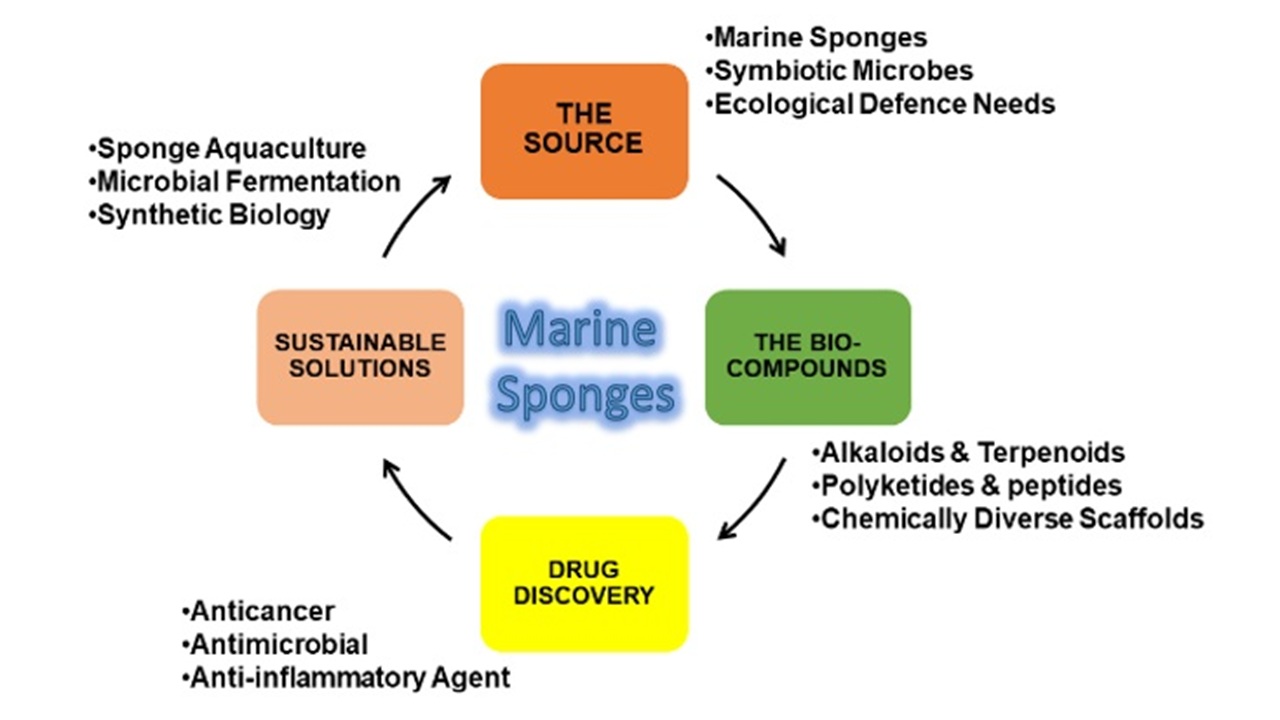
Marine sponges (MS) are attracting a growing interest from the pharmaceutical industry due to their bioactive compounds. A large number of studies being done from MS as regards drug discovery, a multitude of reports on both bioprospecting to separation in addition to synthesis up to biological evaluation exist. The pharmaceutical potential of Actinobacteria and some other notable bioactive molecules, including kryptosiphon crypta, dragmacidin, phorboxazoles, and spirolides is excellent. Drug development can be a promising route from MS compounds, but the marine-derived drugs have been hindered by roadblocks such as sustainable supply of source organisms, process conditions and regulatory approval. Examples of the contribution of marine biodiversity to human health can be seen with compounds already in use such as eribulin, a chemotherapy agent obtained from Halichondria sponges and new drug leads from MS; advancements in biotechnology, chemical ecology and metagenomics have provided novel approaches to tackling existing problems helping pave the way for sustainable discovery and exploitation of potential clinically-relevant products found within the Antarctic environment. This review article reports the bioactive molecules exist from early periods of marine sponges, e.g. halichondrin B and papuamine, as well as their bioreactors for biosynthesis of natural products and natural/bioproducts of commercial importance. It will discuss how sponge–microbe symbiosis matters both in terms of driving innovation in drug discovery, informing sustainability challenges and now also presenting innovative solutions to some these issues.
Article Details

This work is licensed under a Creative Commons Attribution 4.0 International License.
How to Cite




References
M. F. Mehbub, Q. Yang, Y. Cheng, C. M. M. Franco, W. Zhang. Marine Sponge-Derived Natural Products: Trends and Opportunities for the Decade of 2011-2020. Front. Mar. Sci., 2024, 11, 1462825. https://doi.org/10.3389/fmars.2024.1462825 DOI: https://doi.org/10.3389/fmars.2024.1462825
C. Bailly. Pharmacognosy and Natural Product Chemistry of the Marine Sponge Hyrtios Erectus. Eur. J. Med. Chem. Rep., 2025, 15, 100303. https://doi.org/10.1016/j.ejmcr.2025.100303 DOI: https://doi.org/10.1016/j.ejmcr.2025.100303
M. J. Raymond, H. L. Rakotondraibe. Recent Updates on Terpenoids and Other Bioactive Constituents of Marine Sponges. Molecules, 2025, 30, 1112. https://doi.org/10.3390/molecules30051112 DOI: https://doi.org/10.3390/molecules30051112
O. E. Christian, D. A. Perry, A. I. Telchy, P. N. Walton, D. Williams. Bioactive Compounds Isolated from a Marine Sponge Selectively Inhibit Neisseria Gonorrhoeae. Antibiotics, 2024, 13, 1229. https://doi.org/10.3390/antibiotics13121229 DOI: https://doi.org/10.3390/antibiotics13121229
D. Varijakzhan, J. -Y. Loh, W. -S. Yap, K. Yusoff, R. Seboussi, S. -H. E. Lim, K. -S. Lai, C. -M. Chong. Bioactive Compounds from Marine Sponges: Fundamentals and Applications. Marine drugs, 2021, 19, 246. https://doi.org/10.3390/md19050246 DOI: https://doi.org/10.3390/md19050246
N. Barzkar, S. Sukhikh, O. Babich. A Comprehensive Review of Marine Sponge Metabolites, with Emphasis on Neopetrosia Sp. Int. J. Biol. Macromol., 2024, 280, 135823. https://doi.org/10.1016/j.ijbiomac.2024.135823 DOI: https://doi.org/10.1016/j.ijbiomac.2024.135823
J. Liang, J. She, J. Fu, J. Wang, Y. Ye, B. Yang, Y. Liu, X. Zhou, H. Tao. Advances in Natural Products from the Marine-Sponge-Associated Microorganisms with Antimicrobial Activity in the Last Decade. Marine Drugs, 2023, 21, 236. https://doi.org/10.3390/md21040236 DOI: https://doi.org/10.3390/md21040236
J. N. A. Hooper, G. Wörheide, E. Hajdu, D. Erpenbeck, N. J. De Voogd, M. Klautau. Zootaxa 20 Years: Phylum Porifera. Zootaxa, 2021, 4979, 38. https://doi.org/10.11646/zootaxa.4979.1.8 DOI: https://doi.org/10.11646/zootaxa.4979.1.8
V. J. Paul, C. J. Freeman, V. Agarwal. Chemical Ecology of Marine Sponges: New Opportunities through "-Omics." Integr Comp Biol., 2019, 59, 765. https://doi.org/10.1093/icb/icz014 DOI: https://doi.org/10.1093/icb/icz014
P. Li, H. Lu, Y. Zhang, X. Zhang, L. Liu, M. Wang, L. Liu. The Natural Products Discovered in Marine Sponge-Associated Microorganisms: Structures, Activities, and Mining Strategy. Front. Mar. Sci., 2023, 10, 1191858. https://doi.org/10.3389/fmars.2023.1191858 DOI: https://doi.org/10.3389/fmars.2023.1191858
J. J. Bell. The Functional Roles of Marine Sponges. Estuar. Coast. Shelf Sci., 2008, 79, 341. https://doi.org/10.1016/j.ecss.2008.05.002 DOI: https://doi.org/10.1016/j.ecss.2008.05.002
J. -A. Kim, S. Choi, J. K. Lim, E. -S. Kim. Unlocking Marine Treasures: Isolation and Mining Strategies of Natural Products from Sponge-Associated Bacteria. Nat. Prod. Rep., 2025, 42, 1195. https://doi.org/10.1039/D5NP00013K DOI: https://doi.org/10.1039/D5NP00013K
C. Longo, C. Pierri, R. Trani, M. Mercurio, C. Nonnis Marzano, G. Corriero, J. Aguilo-Arce, V. Sini, F. Massari, C. Zambonin. Toward a Green Strategy of Sponge Mariculture and Bioactive Compounds Recovery. Sci. Rep., 2025, 15, 5999. https://doi.org/10.1038/s41598-025-90192-z DOI: https://doi.org/10.1038/s41598-025-90192-z
L. -L. Hong, Y. -F. Ding, W. Zhang, H. -W. Lin. Chemical and Biological Diversity of New Natural Products from Marine Sponges: A Review (2009–2018). Mar Life Sci Technol, 2022, 4, 356. https://doi.org/10.1007/s42995-022-00132-3 DOI: https://doi.org/10.1007/s42995-022-00132-3
A. Amato, R. Esposito, S. Federico, M. Pozzolini, M. Giovine, M. Bertolino, M. Guida, L. Manfra, G. Libralato, V. Zupo. Marine Sponges as Promising Candidates for Integrated Aquaculture Combining Biomass Increase and Bioremediation: An Updated Review. Front. Mar. Sci., 2024, 10, 1234225. https://doi.org/10.3389/fmars.2023.1234225 DOI: https://doi.org/10.3389/fmars.2023.1234225
R. W. Van Soest, N. Boury-Esnault, J. Vacelet, M. Dohrmann, D. Erpenbeck, N. J. De Voogd, N. Santodomingo, B. Vanhoorne, M. Kelly, J. N. Hooper. Global Diversity of Sponges (Porifera). PLoS ONE, 2012, 7, e35105. https://doi.org/10.1371/journal.pone.0035105 DOI: https://doi.org/10.1371/journal.pone.0035105
T. Thomas, L. Moitinho-Silva, M. Lurgi, J. R. Björk, C. Easson, C. Astudillo-García, J. B. Olson, P. M. Erwin, S. López-Legentil, H. Luter. Diversity, Structure and Convergent Evolution of the Global Sponge Microbiome. Nat. Commun., 2016, 7, 11870. https://doi.org/10.1038/ncomms11870 DOI: https://doi.org/10.1038/ncomms11870
A. I. Lavrov, F. V. Bolshakov, D. B. Tokina, A. V. Ereskovsky. Sewing up the Wounds: The Epithelial Morphogenesis as a Central Mechanism of Calcaronean Sponge Regeneration. J. Exp. Zool. B Mol. Dev. Evol., 2018, 330, 351. https://doi.org/10.1002/jez.b.22830 DOI: https://doi.org/10.1002/jez.b.22830
A. Ereskovsky, I. E. Borisenko, F. V. Bolshakov, A. I. Lavrov. Whole-Body Regeneration in Sponges: Diversity, Fine Mechanisms, and Future Prospects. Genes, 2021, 12, 506. https://doi.org/10.3390/genes12040506 DOI: https://doi.org/10.3390/genes12040506
L. -A. Henry, M. Hart. Regeneration from Injury and Resource Allocation in Sponges and Corals - a Review. Internat. Rev. Hydrobiol., 2005, 90, 125. https://doi.org/10.1002/iroh.200410759 DOI: https://doi.org/10.1002/iroh.200410759
J. L. Wulff. Ecological Interactions of Marine Sponges. Can. J. Zool., 2006, 84, 146. https://doi.org/10.1139/z06-019 DOI: https://doi.org/10.1139/z06-019
M. W. Taylor, R. T. Hill, J. Piel, R. W. Thacker, U. Hentschel. Soaking It up: The Complex Lives of Marine Sponges and Their Microbial Associates. ISME J., 2007, 1, 187. https://doi.org/10.1038/ismej.2007.32 DOI: https://doi.org/10.1038/ismej.2007.32
W. Cai, B. MacDonald, M. Korabik, I. Gradin, E. F. Neave, L. R. Harper, E. Kenchington, A. Riesgo, F. G. Whoriskey, S. Mariani. Biofouling Sponges as Natural eDNA Samplers for Marine Vertebrate Biodiversity Monitoring. Sci. Total Environ., 2024, 946, 174148. https://doi.org/10.1016/j.scitotenv.2024.174148 DOI: https://doi.org/10.1016/j.scitotenv.2024.174148
J. B. McClintock, B. J. Baker. A Review of the Chemical Ecology of Antarctic Marine Invertebrates. Amer. Zool., 1997, 37, 329. https://doi.org/10.1093/icb/37.4.329 DOI: https://doi.org/10.1093/icb/37.4.329
S. Patel, L. Naik, A. Rai, K. Palit, A. Kumar, M. Das, D. K. Nayak, P. K. Dandsena, A. Mishra, R. Singh, R. Dhiman, S. Das. Diversity of Secondary Metabolites from Marine Streptomyces with Potential Anti-Tubercular Activity: A Review. Arch. Microbiol., 2025, 207, 64. https://doi.org/10.1007/s00203-024-04233-8 DOI: https://doi.org/10.1007/s00203-024-04233-8
V. M. Nadar, S. Manivannan, R. Chinnaiyan, M. Govarthanan, K. Ponnuchamy. Review on Marine Sponge Alkaloid, Aaptamine: A Potential Antibacterial and Anticancer Drug. Chem. Biol. Drug Des. 2022, 99, 103. https://doi.org/10.1111/cbdd.13932 DOI: https://doi.org/10.1111/cbdd.13932
C. D. Amsler, C. B. Moeller, J. B. McClintock, K. B. Iken, and B. J. Baker. Chemical Defenses against Diatom Fouling in Antarctic Marine Sponges. Biofouling 2000, 16, 29. https://doi.org/10.1080/08927010009378428 DOI: https://doi.org/10.1080/08927010009378428
F. Bibi, M. Faheem, E. I Azhar, M. Yasir, S. A Alvi, M. A Kamal, I. Ullah, M. I Naseer. Bacteria from Marine Sponges: A Source of New Drugs. Curr. Drug Metab., 2017, 18, 11. https://doi.org/10.2174/1389200217666161013090610 DOI: https://doi.org/10.2174/1389200217666161013090610
S. E. Williams, G. Varliero, M. Lurgi, J. E. M. Stach, P. R. Race, P. Curnow. Diversity and Structure of the Deep-Sea Sponge Microbiome in the Equatorial Atlantic Ocean. Microbiology, 2024, 170, 1. https://doi.org/10.1099/mic.0.001478 DOI: https://doi.org/10.1099/mic.0.001478
M. W. Taylor, R. Radax, D. Steger, M. Wagner. Sponge-Associated Microorganisms: Evolution, Ecology, and Biotechnological Potential. Microbiol. Mol. Biol. Rev., 2007, 71, 295. https://doi.org/10.1128/MMBR.00040-06 DOI: https://doi.org/10.1128/MMBR.00040-06
S. Wang, X. Li, W. Yang, R. Huang. Exploring the Secrets of Marine Microorganisms: Unveiling Secondary Metabolites through Metagenomics. Microb. Biotechnol., 2024, 17, e14533. https://doi.org/10.1111/1751-7915.14533 DOI: https://doi.org/10.1111/1751-7915.14533
J. N. Woodhouse, L. Fan, M. V. Brown, T. Thomas, B. A. Neilan. Deep Sequencing of Non-Ribosomal Peptide Synthetases and Polyketide Synthases from the Microbiomes of Australian Marine Sponges. ISME J., 2013, 7, 1842. https://doi.org/10.1038/ismej.2013.65 DOI: https://doi.org/10.1038/ismej.2013.65
S. Zhang, W. Song, L.-F. Nothias, S. P. Couvillion, N. Webster, T. Thomas. Comparative Metabolomic Analysis Reveals Shared and Unique Chemical Interactions in Sponge Holobionts. Microbiome, 2022, 10, 22. https://doi.org/10.1186/s40168-021-01220-9 DOI: https://doi.org/10.1186/s40168-021-01220-9
M. Dell, M. Kogawa, A. B. Streiff, T. Shiraishi, A. Lotti, C. M. Meier, M. A. Schorn, C. Field, J. K. Cahn, H. Yokoyama. Chemical Richness and Diversity of Uncultivated 'Entotheonella' Symbionts in Marine Sponges. Nat. Chem. Biol., 2026, 22, 217. https://doi.org/10.1038/s41589-025-02066-0 DOI: https://doi.org/10.1038/s41589-025-02066-0
F. Lv, Y. Zeng. Novel Bioactive Natural Products from Marine-Derived Penicillium Fungi: A Review (2021–2023). Marine Drugs, 2024, 22, 191. https://doi.org/10.3390/md22050191 DOI: https://doi.org/10.3390/md22050191
M. Jiang, Z. Wu, L. Liu, S. Chen. The Chemistry and Biology of Fungal Meroterpenoids (2009–2019). Org. Biomol. Chem., 2021, 19, 1644. https://doi.org/10.1039/D0OB02162H DOI: https://doi.org/10.1039/D0OB02162H
Y. Zang, R. Sun, R. Feng, H. Zhu, X. Li. Recent Advances of Terpenoids with Intriguing Chemical Skeletons and Biological Activities. Chin. J. Chem., 2025, 43, 443. https://doi.org/10.1002/cjoc.202400697 DOI: https://doi.org/10.1002/cjoc.202400697
C. Jiménez-Romero, L. A. Amador, G. Castro-Falcón, A. D. Rodríguez. Antimicrobial and Anticancer Potential of Polyketides Isolated from the Caribbean Marine Sponge Plakortis Halichondrioides. Drugs and Drug Candidates, 2025, 4, 6. https://doi.org/10.3390/ddc4010006 DOI: https://doi.org/10.3390/ddc4010006
A. Ortigosa-Palomo, F. Quiñonero, R. Ortiz, F. Sarabia, J. Prados, C. Melguizo. Natural Products Derived from Marine Sponges with Antitumor Potential against Lung Cancer: A Systematic Review. Marine Drugs, 2024, 22, 101. https://doi.org/10.3390/md22030101 DOI: https://doi.org/10.3390/md22030101
Y. Yuan, Y. Lei, M. Xu, B. Zhao, and S. Xu. Bioactive Terpenes from Marine Sponges and Their Associated Organisms. Marine Drugs, 2025, 23, 96. https://doi.org/10.3390/md23030096 DOI: https://doi.org/10.3390/md23030096
W. Zhong, Z. Lin, E. W. Schmidt, V. Agarwal. Discovery, Biosynthesis, and Bioactivities of Peptidic Natural Products from Marine Sponges and Sponge-Associated Bacteria. Nat. Prod. Rep., 2025, 42, 2034. https://doi.org/10.1039/D5NP00048C DOI: https://doi.org/10.1039/D5NP00048C
C. Loureiro, A. Galani, A. Gavriilidou, M. Chaib De Mares, J. Van Der Oost, M. H. Medema, D. Sipkema. Comparative Metagenomic Analysis of Biosynthetic Diversity across Sponge Microbiomes Highlights Metabolic Novelty, Conservation, and Diversification. mSystems, 2022, 7, e00357. https://doi.org/10.1128/msystems.00357-22 DOI: https://doi.org/10.1128/msystems.00357-22
V. Mazzella, A. Dell'Anno, N. Etxebarría, B. González-Gaya, G. Nuzzo, A. Fontana, L. Núñez-Pons. High Microbiome and Metabolome Diversification in Coexisting Sponges with Different Bio-Ecological Traits. Commun. Biol., 2024, 7, 422. https://doi.org/10.1038/s42003-024-06109-5 DOI: https://doi.org/10.1038/s42003-024-06109-5
C. Grosso, P. Valentão, F. Ferreres, P. B. Andrade. Alternative and Efficient Extraction Methods for Marine-Derived Compounds. Mar. Drugs, 2015, 13, 3182. https://doi.org/10.3390/md13053182 DOI: https://doi.org/10.3390/md13053182
S. S. Ebada, R. A. Edrada, W. Lin, P. Proksch. Methods for Isolation, Purification and Structural Elucidation of Bioactive Secondary Metabolites from Marine Invertebrates. Nat. Protoc., 2008, 3, 1820. https://doi.org/10.1038/nprot.2008.182 DOI: https://doi.org/10.1038/nprot.2008.182
T. U. Jayawardena, N. Merindol, N. S. Liyanage, F. Awwad, I. Desgagne-Penix. Marine Specialized Metabolites: Unveiling Nature's Chemical Treasures from the Deep Blue. TrAC - Trends Anal. Chem., 2025, 183, 118097. https://doi.org/10.1016/j.trac.2024.118097 DOI: https://doi.org/10.1016/j.trac.2024.118097
S. Ma, C. Cai, Q. Lu, Z. Tan. A Review of Green Solvents for the Extraction and Separation of Bioactive Ingredients from Natural Products. Food Chemistry, 2025, 478, 143703. https://doi.org/10.1016/j.foodchem.2025.143703 DOI: https://doi.org/10.1016/j.foodchem.2025.143703
S. U. Kadam, B. K. Tiwari, C. P. O'Donnell. Application of Novel Extraction Technologies for Bioactives from Marine Algae. J. Agric. Food Chem., 2013, 61, 4667. https://doi.org/10.1021/jf400819p DOI: https://doi.org/10.1021/jf400819p
H. R. El-Seedi, M. S. Refaey, N. Elias, M. F. El-Mallah, F. M. K. Albaqami, I. Dergaa, M. Du, M. F. Salem, H. E. Tahir, M. Dagliaa, N. Yosri, H. Zhang, A. H. El-Seedi, Z. Guo, S. A. M. Khalifa. Marine Natural Products as a Source of Novel Anticancer Drugs: An Updated Review (2019–2023). Nat. Prod. Bioprospect., 2025, 15, 13. https://doi.org/10.1007/s13659-024-00493-5 DOI: https://doi.org/10.1007/s13659-024-00493-5
S. B. Bharate, S. D. Sawant, P. P. Singh, R. A. Vishwakarma. Kinase Inhibitors of Marine Origin. Chem. Rev., 2013, 113, 6761. https://doi.org/10.1021/cr300410v DOI: https://doi.org/10.1021/cr300410v
G. Ercolano, P. De Cicco, A. Ianaro. New Drugs from the Sea: Pro-Apoptotic Activity of Sponges and Algae Derived Compounds. Marine Drugs, 2019, 17, 31. https://doi.org/10.3390/md17010031 DOI: https://doi.org/10.3390/md17010031
D. S. Dalisay, C. P. Tenebro, E. M. Sabido, A. F. L. Suarez, M. J. V. Paderog, R. Reyes-Salarda, J. P. Saludes. Marine-Derived Anticancer Agents Targeting Apoptotic Pathways: Exploring the Depths for Novel Cancer Therapies. Marine Drugs, 2024, 22, 114. https://doi.org/10.3390/md22030114 DOI: https://doi.org/10.3390/md22030114
Y. S. Anteneh, Q. Yang, M. H. Brown, C. M. Franco. Antimicrobial Activities of Marine Sponge-Associated Bacteria. Microorganisms, 2021, 9, 171. https://doi.org/10.3390/microorganisms9010171 DOI: https://doi.org/10.3390/microorganisms9010171
A. M. P. Magri, I. R. Avanzi, G. T. Vila, R. N. Granito, D. Estadella, P. C. Jimenez, A. M. Ribeiro, A. C. M. Rennó. Anti-Inflammatory Effects of Compounds Extracted from Marine Sponges: A Systematic Review. AIAAMC 2023, 22, 164. https://doi.org/10.2174/0118715230272152231106094727 DOI: https://doi.org/10.2174/0118715230272152231106094727
A. Kumar, A. Soratur, S. Kumar, and B. A. Venmathi Maran. A Review of Marine Algae as a Sustainable Source of Antiviral and Anticancer Compounds. Macromol, 2025, 5, 11. https://doi.org/10.3390/macromol5010011 DOI: https://doi.org/10.3390/macromol5010011
M. Maslin, N. Gaertner-Mazouni, C. Debitus, N. Joy, R. Ho. Marine Sponge Aquaculture towards Drug Development: An Ongoing History of Technical, Ecological, Chemical Considerations and Challenges. Aquac. Rep., 2021, 21, 100813. https://doi.org/10.1016/j.aqrep.2021.100813 DOI: https://doi.org/10.1016/j.aqrep.2021.100813
K. Hesp, J. M. van der Heijden, S. Munroe, D. Sipkema, D. E. Martens, R. H. Wijffels, and S. A. Pomponi. First Continuous Marine Sponge Cell Line Established. Sci. Rep., 2023, 13, 5766. https://doi.org/10.1038/s41598-023-32394-x DOI: https://doi.org/10.1038/s41598-023-32394-x
D. Jung, K. Machida, Y. Nakao, J. S. Owen, S. He, T. Kindaichi, A. Ohashi, Y. Aoi. Cultivation of Previously Uncultured Sponge-Associated Bacteria Using Advanced Cultivation Techniques: A Perspective on Possible Key Mechanisms. Front. Mar. Sci., 2022, 9, 963277. https://doi.org/10.3389/fmars.2022.963277 DOI: https://doi.org/10.3389/fmars.2022.963277
C. M. Brinkmann, A. Marker, D. I. Kurtböke. An Overview on Marine Sponge-Symbiotic Bacteria as Unexhausted Sources for Natural Product Discovery. Diversity, 2017, 9, 40. https://doi.org/10.3390/d9040040 DOI: https://doi.org/10.3390/d9040040
C. Lasch, M. Myronovskyi, A. Luzhetskyy. Streptomyces as a Versatile Host Platform for Heterologous Production of Microbial Natural Products. Nat. Prod. Rep., 2026., 43, 371. https://doi.org/10.1039/D5NP00036J DOI: https://doi.org/10.1039/D5NP00036J
M. Costantini. Genome Mining and Synthetic Biology in Marine Natural Product Discovery. Marine Drugs, 2020, 18, 615. https://doi.org/10.3390/md18120615 DOI: https://doi.org/10.3390/md18120615
R. U. Chidugu-Ogborigbo, U. S. Nkopuyo, J. H. Nikolas, J. Barker. Bioaccumulation and Genotoxic Effect of Heavy Metal Pollution in Marine Sponges from the Niger Delta. Mar. Pollut. Bull., 2025, 211, 117386. https://doi.org/10.1016/j.marpolbul.2024.117386 DOI: https://doi.org/10.1016/j.marpolbul.2024.117386
P. Bhatia, A. Chugh. Role of Marine Bioprospecting Contracts in Developing Access and Benefit Sharing Mechanism for Marine Traditional Knowledge Holders in the Pharmaceutical Industry. Glob. Ecol. Conserv., 2015, 3, 176. https://doi.org/10.1016/j.gecco.2014.11.015 DOI: https://doi.org/10.1016/j.gecco.2014.11.015
T. T. H. Dat, G. Steinert, N. T. K. Cuc, P. V. Cuong, H. Smidt, D. Sipkema. Diversity of Bacterial Secondary Metabolite Biosynthetic Gene Clusters in Three Vietnamese Sponges. Marine Drugs, 2022, 21, 29. https://doi.org/10.3390/md21010029 DOI: https://doi.org/10.3390/md21010029
M. Y. Alazaiza, A. A. B. Mokaizh, A. H. Nour, T. M. Alzghoul, A. O. Baarimah. Green Extraction of Natural Products: A Bibliometric Review of Global Research Trends, Technological Advances, and Environmental Implications. Results in Eng., 2025, 29, 108913. https://doi.org/10.1016/j.rineng.2025.108913 DOI: https://doi.org/10.1016/j.rineng.2025.108913
B. Raj, D. S. Seetharam, S. J. Patil. Green Extraction of Bioactive Compounds from Marine Constituents. Scripta Medica, 2025, 56, 329. https://doi.org/10.5937/scriptamed56-52550 DOI: https://doi.org/10.5937/scriptamed56-52550
Q. Xu, Y. Jin. Benefit Sharing of Marine Genetic Resources and Intellectual Property Protection under the BBNJ Agreement. Front. Mar. Sci., 2025, 12, 1631043. https://doi.org/10.3389/fmars.2025.1631043 DOI: https://doi.org/10.3389/fmars.2025.1631043
A. Ramanjooloo, R. J. Andersen, A. Bhaw-Luximon. Marine Sponge-Derived/Inspired Drugs and Their Applications in Drug Delivery Systems. Future Med. Chem. 2021, 13, 487. https://doi.org/10.4155/fmc-2020-0123 DOI: https://doi.org/10.4155/fmc-2020-0123
S. A. Dyshlovoy F. Honecker. Marine Compounds and Cancer: The First Two Decades of XXI Century. Marine Drugs, 2019, 18, 20. https://doi.org/10.3390/md18010020 DOI: https://doi.org/10.3390/md18010020
M. Barreca, V. Spanò, A. Montalbano, M. Cueto, A. R. Díaz Marrero, I. Deniz, A. Erdoğan, L. Lukić Bilela, C. Moulin, E. Taffin-de-Givenchy. Marine Anticancer Agents: An Overview with a Particular Focus on Their Chemical Classes. Marine drugs, 2020, 18, 619. https://doi.org/10.3390/md18120619 DOI: https://doi.org/10.3390/md18120619
C. C. Hardoim, R. Costa. Microbial Communities and Bioactive Compounds in Marine Sponges of the Family Irciniidae—a Review. Marine Drugs, 2014, 12, 5089. https://doi.org/10.3390/md12105089 DOI: https://doi.org/10.3390/md12105089
X. Tian, C. Lyu, Y. Zhou, L. Zhang, A. Fan, Z. Liu. A Structure-Based Deep Learning Framework for Correcting Marine Natural Products' Misannotations Attributed to Host–Microbe Symbiosis. Marine Drugs, 2026, 24, 20. https://doi.org/10.3390/md24010020 DOI: https://doi.org/10.3390/md24010020
Y. Xu, X. Du, X. Yu, Q. Jiang, K. Zheng, J. Xu, P. Wang. Recent Advances in the Heterologous Expression of Biosynthetic Gene Clusters for Marine Natural Products. Marine drugs, 2022, 20, 341. https://doi.org/10.3390/md20060341 DOI: https://doi.org/10.3390/md20060341
E. S. Botté, S. Nielsen, M. A. Abdul Wahab, J. Webster, S. Robbins, T. Thomas, N. S. Webster. Changes in the Metabolic Potential of the Sponge Microbiome under Ocean Acidification. Nat. Commun., 2019, 10, 4134. https://doi.org/10.1038/s41467-019-12156-y DOI: https://doi.org/10.1038/s41467-019-12156-y
N. Haque, S. Parveen, T. Tang, J. Wei, Z. Huang. Marine Natural Products in Clinical Use. Marine Drugs, 2022, 20, 528. https://doi.org/10.3390/md20080528 DOI: https://doi.org/10.3390/md20080528
S. Zhao, R. Feng, Y. Gu, L. Han, X. Cong, Y. Liu, S. Liu, Q. Shen, L. Huo, F. Yan. Heterologous Expression Facilitates the Discovery and Characterization of Marine Microbial Natural Products. Eng. Microbiol., 2024, 4, 100137. https://doi.org/10.1016/j.engmic.2023.100137 DOI: https://doi.org/10.1016/j.engmic.2023.100137